|
|
|
Bariatric
surgery is a type of procedure
performed on people for the purpose of
losing weight. Bariatric surgical
procedures are only considered for
people with severe obesity and not for
individuals with a mild weight problem
and who are overweight. If other
methods to lose weight haven�t worked
for you, a bariatric surgery may help.
|
|
Intragastric Balloon |
|
|
|
|
|
|
Procedure Type - Restrictive
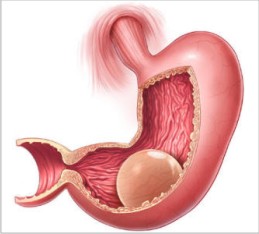
The Intra Gastric Balloon is a
non-surgical aid in the treatment of
obesity. The Intra Gastric Balloon is
a soft, expandable; silicone balloon
placed inside the stomach via
endoscopy (enters through the mouth
and into the stomach with or without
sedation).
How Does the Intra Gastric Balloon
Work?
A soft balloon fills a large portion
of the stomach, and therefore |
 |
| |
reduces the capacity of the stomach.
This creates a feeling of fullness for
the patient and does not allow for
overeating, therefore allowing the
patient to effectively diet without
feeling continuously hungry.
The first week you will be on a liquid
and puree diet. Post this period, you
can begin a solid diet with
recommendations from the nutritionist.
During the six month period when the
balloon is in place, the Nutritionist
will monitor your progress. You will
receive education and training on
nutrition and lifestyle changes for
long-term success. After the BIB is
removed, you will continue to meet our
team for additional support and
guidance if needed. |
|
|
|
|
|
� |
Digestion and absorption will be
normal |
|
� |
When eating less, the body draws the
required energy from its own fat |
|
|
|
Surgical Time: |
15 minutes |
|
Hospitalization: |
2 hours |
|
Recovery: |
24 � 48 hours |
|
Result: |
The mean weight loss after six
months is 15 to 25 Kgs |
|
|
|
|
|
Laparoscopic Gastric Banding |
|
|
|
|
| |
Procedure Type - Restrictive
The gastric banding is the least
invasive of all procedures.
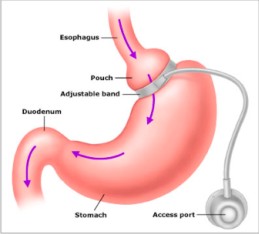
An adjustable silicon band is placed
around the stomach to create a small
stomach. Small quantity of food can
fill up the small stomach providing
satisfaction/satiety to the person.
Narrow outlet of this small stomach
delays progression of food into
intestine � person feels full for
longer period. The size of
|
 |
| |
the stomach opening can be
adjusted by injecting saline
through a button under the skin.
Person is able to eat smaller
meals at long interval. |
|
|
|
|
Surgical Time: |
30-60 minutes |
|
Hospitalization: |
2 hours |
|
Recovery: |
4 days |
Dietary Advice:
Daily mandatory intake of protein with
a multivitamin intake will prevent any
possible nutritional deficiency.
Special dietary advice is provided to
post-op patients & regular follow-up
is essential.
Complications after gastric band
surgery has reduced significantly over
a period of time with change in
dissection technique, band design and
is the safest procedure. |
|
� |
Surgery can be reversed |
|
� |
Digestion and absorption is normal |
|
� |
When eating less the body draws the
required energy from its own fat |
|
|
Results:
The mean weight loss at two years
after surgery is 40-55% of excess
weight.
Most patients have significant
improvements in their associated
diseases as they lose weight. The
reported incidence for common diseases
is as follows. |
|
|
|
Diabetes: |
Improvement in >45-80% |
|
Hyperlidemia: |
Resolution in >70% |
|
Hypertension: |
Improvement in 38-70% |
|
Sleep Apnea: |
Resolution in >90% |
|
|
|
Usually band adjustment is required
only 1-2 times during the lifetime.
This procedure requires 15-30 minutes
only. |
|
|
|
|
Laparoscopic Sleeve Gastrectomy |
|
|
|
|
|
|
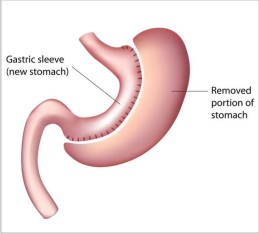
Procedure Type - Restrictive
Advantages of the Sleeve Gastrectomy |
 |
|
� |
It does not require disconnecting or
reconnecting the intestines and food
absorption is normal |
|
� |
It is a technically simpler operation
than the gastric bypass |
|
� |
It is known to reduce hunger because
hunger stimulating hormone producing
part of stomach is removed |
|
|
� |
Unlike gastric bypass & gastric band,
patients will feel full with liquids
as well |
|
|
|
Surgical Time: |
60 minutes |
|
Hospitalization: |
24 hours |
|
Recovery: |
4 days |
|
|
|
Results: |
|
� |
Patients lose 60-90% of weight by the
end of two years |
|
� |
90-98% resolution of diabetes,
hypertension, hyperlipidemia, sleep
apnea, knee joint pain and much better
quality of life |
|
� |
Provides satiety with small amount of
food |
|
� |
No mal-absorption |
|
|
|
|
Laparoscopic Roux en Y Gastric Bypass |
|
|
|
|
|
|
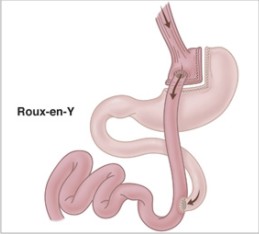
Procedure Type Combined Restrictive /
Mal-absorptive
Stapling
is used to create a small, upper
stomach pouch leading to early
satiety/satisfaction with small
quantity of food. Essentially a large
part of stomach & small intestine is
bypassed, so that food & digestive
juices mix with each other distally.
This results in delayed & reduced
absorption of nutrients & calories. |
 |
|
|
|
|
Surgical Time: |
2-3 hours |
|
Hospitalization: |
2 days |
|
Recovery: |
4 days |
|
|
|
Results: |
|
� |
Avg. of 77% of excess body weight loss
one year after surgery |
|
� |
Studies show that even after 14 years
of surgery, patients have maintained
80% of excess body weight loss |
|
� |
Study of 20000 patients showed that
96% of associated health conditions
were improved or resolved, including
back pain, sleep apnea, high blood
pressure, type II diabetes and
depression |
|
� |
In most cases, patients report an
early sense of fullness, combined with
a sense of satisfaction, that reduces
the desire to excessive eating |
|
|
|
|
Laparoscopic approach to weight loss
surgery |
|
|
|
|
|
|
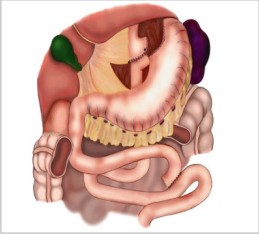
All the
procedures are performed through
laparoscopy. When a laparoscopic
operation is performed, a small video
camera inserted into the abdomen
allows the surgeon to conduct and view
the surgery on a video monitor.
The camera
and surgical instruments are usually
inserted through small incisions made
in the abdominal wall.
Laparoscopic procedures for weight
loss surgery employ the same
principles as their 'open' |
 |
|
|
counterparts and produce similar
excess weight loss. Compared to open
surgery, some benefits of laparoscopic
surgery include faster recovery and
return to pre-surgical level of
activity.
Modern
laparoscopic treatment offers the
following advantages |
|
� |
Short stay (24-48 hrs) |
|
� |
Practically pain free |
|
� |
No wound related complications |
|
� |
Patients returns to work in less than
a week |
|
� |
Cosmetically 5 tiny scars � - 1 � cm |
|
� |
Low complication rate comparable to
any other surgery |
|
� |
Improves overall quality of life (QOL) |
|
|
Risk:
All major surgery involves a certain
level of risk. Risks involved with
weight loss surgery vary according to
procedure performed. |
|
|
Complications: |
|
� |
Re-operation rate 1% |
|
� |
Anastomotic leak 1% |
|
� |
Anastomotic stricture 2% |
|
� |
Wound infection 1%. |
|
� |
Obstruction 5% |
|
� |
Deep vein thrombosis 1% |
|
|
Side Effects: |
|
� |
Restriction of eating small meal
indefinitely |
|
� |
Occasional Vomiting / Regurgitations |
|
� |
Minor hair loss |
|
� |
Occasional constipation |
|
� |
Loose / Boggy skin |
|
� |
Deficiency of Protein /Vitamins if
supplements are stopped |
|
|
Important considerations for all
weight-loss surgery |
|
� |
Weight loss surgery is not a cosmetic
surgery |
|
� |
The decision to elect surgical
treatment requires an assessment of
the risk and benefit to you and the
meticulous performance of the
appropriate surgical procedure |
|
� |
The success of weight loss surgery is
dependent on your long term lifestyle
changes in diet, exercise and behavior
modification |
|
� |
In a survey of over 10,000 patients,
the mortality rate for weight loss
surgery was 0.30% |
|
|
|
|
|
<< Back to the
Top |
|
|
|
|
|