|
|
|
We offer the following treatments and
surgeries: |
|
� |
Removal of
kidney stones |
|
� |
Removal of
an enlarged prostate gland |
|
� |
Removal of
the kidney (Laparoscopic Nephrectomy) |
|
|
|
|
Removal Of Kidney Stones |
|
|
|
|
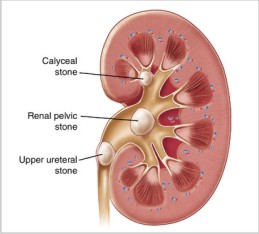
Kidney stones are also called
�renal calculi�. They can form
anywhere in the urinary system,
but are commonly found in the
kidney. Their size can be as
small as a microscopic crystal,
to as large as a golf ball. Most
calculi however, pass straight
through the urinary tract
without causing problems.
|
|
|
|
|
Symptoms |
|
� |
Sudden, excruciating pain in the side
(which cannot be subdued by a change
in body position) |
|
 |
|
|
� |
Nausea and vomiting due to severe pain |
|
� |
Blood in urine |
|
� |
Difficulty in urinating |
|
� |
Progressive breathing problems |
|
|
|
|
|
Causes |
|
� |
Often formed when insufficient urine
is being passed or when urine contains
high levels of minerals like calcium
and phosphorous |
|
� |
Dehydration |
|
� |
May also result from infections of the
urinary tract. |
|
|
|
|
|
Solution |
|
� |
A surgical procedure called
�Percutaneous Nephrolithotomy� is
performed by the surgeon, in which, a
small puncture wound (up to about 1
cm) is used to pass a needle into the
pelvis of the kidney. The position of
the needle is confirmed by
fluoroscopy. A guide wire is passed
through the needle into the pelvis.
The needle is then withdrawn with the
guide wire still inside the pelvis.
Over the guide wire the dilators are
passed and a working sheath is
introduced. A nephroscope is then
passed inside and the small stones
taken out |
|
� |
If the stones are large, they are
first pulverized using ultrasound
probes, after which, they are
extracted |
|
� |
As this surgery is percutaneous,
involving just a tiny puncture rather
than an open incision, there is
minimal scarring or post-operative
stress |
|
� |
In contrast to laparoscopy, no
insufflation is used. The percutaneous
tract provides direct access to the
kidney for stone removal. |
|
|
|
|
|
<< Back to the
Top |
|
|
|
|
Removal of Prostate Gland |
|
|
|
|
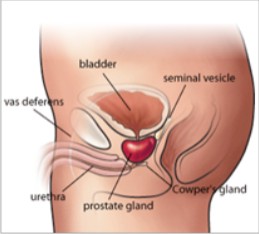
The prostate gland is a fibrous organ
that surrounds the urinary canal in
men. An enlarged prostate gland can
compress the urethra, thus causing
problems with urination. Transurethral
resection of the prostate (TURP) is a
simple surgical procedure that is used
to remove, all or part of the prostate
gland. It is the preferred treatment
for a condition known as �Benign
Prostatic Hyperplasia� (BPH) which
results in swelling of the prostate
gland constriction in the urinary
canal. Men over the age of 40 are more
likely to develop swollen prostate
glands. |
 |
|
|
|
|
|
|
Symptoms |
|
� |
Increase in frequency of urination
especially during the night |
|
� |
Difficulty in starting urine flow |
|
� |
A slow, interrupted flow and dribbling
after urinating |
|
� |
Sudden, strong urges to pass urine |
|
� |
A sensation that the bladder is not
completely empty |
|
� |
Pain or burning during urination |
|
|
|
|
|
Causes |
|
� |
Androgens (male hormones) play a
passive, if not an active role in the
development of BPH |
|
� |
Testosterone also may play a part in
prostate cell proliferation |
|
|
|
|
|
Solution |
|
� |
A dose of general or regional
anaesthesia is administered, before
which the urethra is examined using a
cytoscope (a flexible surgical camera
used to view the interior of the
Urinary canal |
|
� |
A special tool is then used to remove
the prostate gland piece by piece |
|
|
|
|
|
Preparation for TURP |
|
� |
Complete physical examination is
required |
|
� |
Consult your doctor regarding the
drugs, supplements and vitamins you
are taking |
|
� |
TURP has a high-success rate, and is
found to reduce symptoms in 88% of BPH
patients |
|
|
|
|
|
<< Back to the
Top |
|
|
|
|
Removal of the kidneys (Laparoscopic
Nephrectomy) |
|
|
|
|
The kidneys are paired organs that lie
at the rear of the abdomen, in the
area of your lower back. They serve
the body as natural filters by
removing waste materials from human
blood. These waste materials are
diverted to the urinary bladder.
However, sometimes, major
complications arise in the kidney due
to which it has to be surgically
removed through the process of �Nephrectomy�.
|
|
|
|
|
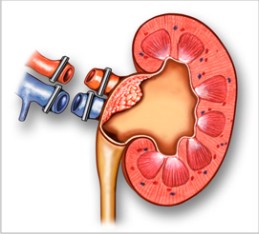
Removal of
the kidney is needed in cases such as- |
|
 |
|
|
� |
Tumor in
the kidney |
|
� |
Non-functioning kidney |
|
� |
Long-standing infections in the kidney
(known as �Chronic pyelonephritis�)
that could potentially spread and
damage other areas |
|
� |
Narrowing
of arteries in the kidney resulting in
high blood pressure (known as
�Reno-vascular hypertension�) |
|
� |
Long-term kidney damage caused by high
blood pressure (known as �Nephrosclerosis�) |
|
� |
Symptomatic patients with autosomal
dominant polycystic kidney disease |
|
� |
Obstruction of the urinary canal
causes �Reflux or Obstructive
nephropathy� which affects the kidney |
|
� |
An abnormal kidney that was malformed
during growth in the womb (known as
�Multi-cystic dysplastic� kidney) |
|
|
|
|
|
Procedure |
|
� |
Laproscopic Nephrectomy is performed
under general anesthesia. |
|
� |
A laparoscope (thin tube with an
attached camera and light source) is
inserted through incisions (single or
multiple) in the body. Surgical
instruments are then passed through
the laparoscope and the kidney is
removed |
|
|
|
|
|
<< Back to the
Top |
|
|
|
|