|
|
|
We offer the following treatments and
surgeries: |
|
• |
Removal of fibroids |
|
• |
Removal of uterus |
|
• |
Removal of cysts in ovaries |
|
• |
Pelvic organ prolapse |
|
• |
Treatment of ectopic pregnancy
(pregnancy outside the uterus) |
|
• |
Diagnosis of infertility |
|
• |
Sterilization |
|
|
|
|
Removal of fibroids (Myomectomy) |
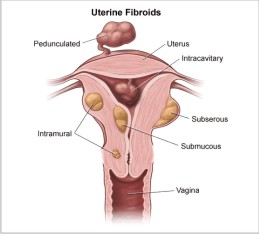
Fibroids
are non-cancerous tumors of the uterus
found in almost 25% of women in the
reproductive age group (25-50 years of
age).
|
|
|
|
|
|
Symptoms
of fibroids |
 |
|
• |
Excessive
bleeding during periods |
|
• |
Feelings
of heaviness and lethargy |
|
• |
Abdominal
pain |
|
• |
Lump in
the abdomen in the cases of large
fibroids |
|
• |
Difficulty
in passing urine |
|
• |
Constipation |
|
|
|
|
|
Solution |
|
|
• |
Laparoscopic Myomectomies (Fibroid
Removals) are very patient-friendly
surgeries. The fibroid is detached
from the uterus, the capsule is
sutured and then finally, the fibroid
is removed with the help of an
instrument called a Morcellator |
|
• |
Surgery,
bleeding and post-operative procedures
take only about a day. Post-operation
pain is minimal |
|
• |
The
fibroid may also be removed with a
single incision near the umbilicus
(navel), but this depends on the
surgeon’s expertise and the size of
the fibroid |
|
• |
Myomectomies are quick, relatively
painless, and patient-friendly. It is
the best solution for women with
fibroids. The expertise of our
surgeons, the safety of our
anesthesia, the teamwork and the
quality of our equipment remain the
hallmarks and guarantee of a good and
surgical outcome |
|
|
|
|
|
|
<< Back to the
Top |
|
| |
|
|
|
|
|
|
|
Removal of uterus (Hysterectomy) |
|
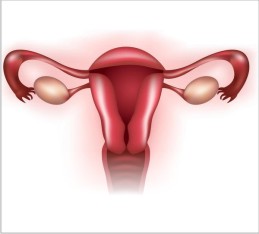
Hysterectomy is the surgical removal
of the uterus (womb) and is performed
when a woman has health problems
related to it after her child bearing
is complete (age 45+ years).
|
|
|
 |
|
|
Symptoms |
|
• |
Severe
pain |
|
• |
Bleeding
during menstruation |
|
• |
Other
damaged organs |
|
|
|
|
|
Causes |
|
• |
The
presence of fibroids |
|
• |
The
prolapse of the uterus (where the
Uterus is shifted from its usual
position) |
|
• |
Endometriosis (Presence of the uterus
lining in nearby organs which causes
pain and bleeding) |
|
• |
Uterine or
cervical cancer |
|
|
|
|
|
|
|
Solution |
|
|
• |
In most
cases, the surgery is done through a
tiny incision in the abdomen except in
a few exceptional cases where the
uterus is so large that there isn’t
enough room to insert the laparoscopic
equipment |
|
• |
In the
hysterectomy, the uterus and the
surrounding supportive tissue are
separated with special tools which
maximize efficiency while minimizing
blood loss and time of surgery |
|
• |
The uterus
is then removed through the birth
canal, or, in special instances, by
morcellation. |
|
• |
After
hysterectomy, a woman will no longer
have her periods |
|
|
|
|
|
|
<< Back to the
Top |
|
| |
|
|
|
|
|
|
|
Removal of cysts in ovaries |
|
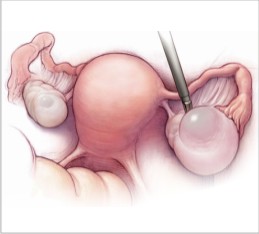
Ovarian
cysts are small fluid-filled sacs that
develop in a woman's ovaries. In some
cases, the cysts may dissolve after
some time. This is common in women of
the younger age group and in such
cases, only observation is needed.
Surgery is
needed in most cases due to the large
size of the cyst, torsion of the cyst
or due to the fear of it becoming
cancerous. Cysts may be benign
(non-cancerous) or malignant
(cancerous), in which case, surgery is
urgent and required.
|
|
|
|
|
|
Symptoms |
 |
|
• |
Fullness
in the abdomen |
|
• |
Painful
periods and abnormal bleeding |
|
• |
Problems
passing urine completely |
|
• |
Pain with
fever and vomiting |
|
|
|
|
|
Solution |
|
• |
Surgery
can be done for most of these ovarian
cysts except in later-stage ovarian
cancerous cysts. |
|
• |
In
surgery, the laparoscope (a flexible
surgical device equipped with a
camera, forceps, scissors and more) is
used to locate the cyst. Once located,
one or two more tiny incisions are
made, through which surgical
instruments are inserted to remove the
cyst. The cyst can be extracted intact
or it can be aspirated and cyst wall
can be either cut off or eroded. The
removed tissue should be sent for
biopsy. |
|
|
|
|
|
|
<< Back to the
Top |
|
|
|
|
|
|
|
|
|
Surgery For Pelvic Organ Prolapse |
|
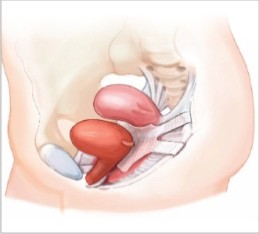
Pelvic
prolapse is a weakness or laxity in
the supporting structures of the
pelvic organs.
Tissue
from the bladder, uterus or rectum may
protrude into the vagina or into other
organs. Pelvic Organ Prolapse is
actually a rather common condition
amongst older
|
|
women.
Indeed, it is estimated that nearly
half of the women with children will
experience some sort of prolapse in later years. It is also
possible that many organs may be
prolapsed. Organs susceptible to
collapse include : |
 |
|
• |
Bladder |
|
• |
Rectal
Walls |
|
• |
Small
Bowel |
|
• |
Uterus |
|
• |
Vaginal
vault |
|
|
|
|
|
<< Back to the
Top |
|
| |
|
|
|
|
|
|
|
Ectopic (or Tubal) Pregnancy |
|
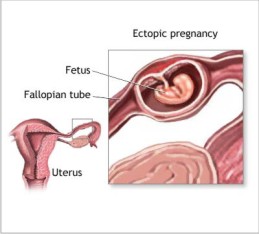
This is a
pregnancy that develops outside the
womb, usually in one of the fallopian
tubes but perhaps even in the abdomen
or ovaries. Approximately 2 in every
100 pregnancies in India may result in
ectopic pregnancy.
|
|
|
|
|
|
Symptoms |
 |
|
• |
Severe,
one-sided and persistent abdominal
pain is a common symptom |
|
• |
Unconsciousness or collapse, preceded
by weakness and dizziness |
|
• |
Diarrhea
or vomiting |
|
• |
Vaginal
bleeding (You may not know that you’re
pregnant and mistaken this for a
period, but this blood is usually
different from the menses - it is
often dark and watery) |
|
• |
Shoulder-tip pain- This may indicate
internal bleeding that irritates other
organs |
|
• |
Pain
during urination or defecation |
|
|
|
|
|
|
Long
Term Risks |
|
|
• |
Severe
abdominal pain |
|
• |
If
unrecognized, fallopian tubes may
rupture, causing internal bleeding.
This is a medical emergency and may be
fatal. |
|
|
|
|
|
|
Causes |
|
|
• |
Pelvic
infection |
|
• |
Endometriosis in the fallopian tubes
(where the uterine lining is present
against the fallopian tubes) |
|
• |
Any
previous abdominal surgeries |
|
• |
Intra
uterus contraceptive devices |
|
|
|
|
|
|
Solutions |
|
|
• |
In the
case of ectopic pregnancies, one may
require observation, a laparoscopy or
maybe even a laparotomy |
|
• |
For those
who require surgical intervention, the
most common treatment is surgery, in
which case, laparoscopies are
preferred due to the tiny incisions
used and the speedy recovery
afterwards. Under ideal conditions, an
incision can be made, and the
pregnancy removed, leaving the
fallopian tube intact |
|
• |
In some
serious cases, the damage may require
the removal of a portion of the tube,
the entire tube, the ovary perhaps and
maybe even the uterus |
|
• |
However,
certain conditions make laparoscopy
less effective or unavailable as an
alternative. These include massive
pelvic scar tissue and excessive blood
in the abdomen or pelvis |
|
|
|
|
|
|
<< Back to the
Top |
|
| |
|
|
|
|
|
|
|
Laparoscopy for infertility |
|
|
|
|
|
• |
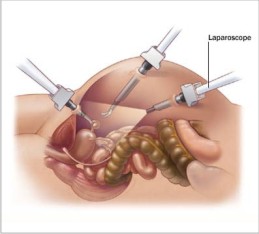
Here, we
surgically observe and check for any
abnormalities in the uterus, fallopian
tubes and ovaries, such as scar
tissue, endometriosis, fibroids,
cysts, congenital defects or others |
 |
|
• |
In some
women, the fallopian tubes are
blocked, which prevents the fusion of
sperm and egg cells, causing
infertility. With laparoscopy, any
defects that are found may be
corrected |
|
• |
Sterilization can be done with
laparoscopy or mini-laparotomy |
|
• |
In the
laparotomy, the abdomen is cut about
3-4 cm |
|
• |
In
laparoscopy, complete sterilization
can be made with a small incision near
the navel. A special device for
grasping the fallopian tubes is
inserted through a second, small
incision made at the pubic hairline.
The fallopian tubes are sealed either
with an electric current that makes
the tube clot (electrocoagulation) or
with a band or clip that is placed
over the tubes or they may be cut.
After the fallopian tubes have been
sealed, the instruments are removed
and a small bandage is applied over
the incisions |
|
|
|
|
|
|
<< Back to the
Top |
|
| |
|
|
|
|
|
|
|
Laparoscopic sterilization |
|
|
|
|
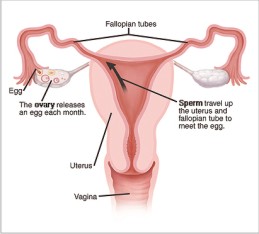
Sterilization or Tubal ligation (also
known as "tying the tubes") is a
surgery that is used to close a
woman's fallopian tubes so that she
can no longer get pregnant.
The fallopian tubes are on either side
of the uterus and extend toward the
ovaries. They receive eggs from the
ovaries and transport them to the
uterus. Once the fallopian tubes are
closed, the man's sperm can no longer
fuse with the egg, making conception
impossible. |
 |
|
|
|
|
|
|
<< Back to the
Top |
|
|
|
|
|
|
|
|